

So you’ve earned a trove of credit card points. What next?
Understanding what to do with those points can be one of the most complicated parts about the points and miles game. Let’s break it down into a few steps to cover the basics
- What is a transfer partner
- Why not all partners are equal
- Why not all points programs are equal
- What is a transfer ratio
- How does transfer timing work
- When to transfer vs when to book direct
what is a transfer partner
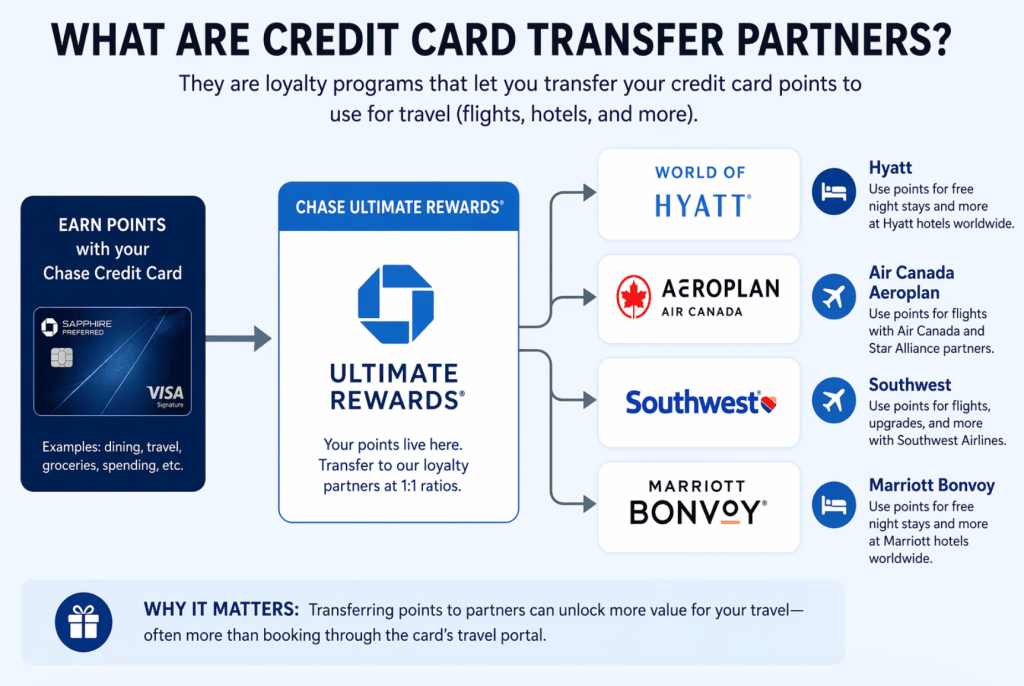
Most credit card points don’t live in a vacuum. When you hold a card that earns Chase Ultimate Rewards, Amex Membership Rewards, or a few other points currencies, you’re sitting on a currency that can move, and where it moves is where the real value hides.
A transfer partner is simply an airline or hotel loyalty program that your credit card issuer has a direct relationship with. Instead of booking travel through your card’s portal (where points are often worth a flat ~1–1.5 cents each), transferring your points into one of these partner programs unlocks the ability to book awards there, potentially at a significantly better rate. If this math sounds confusing, start with the “101” article and “201” article.
Think of it like currency exchange. Your Chase Ultimate Rewards points are like US dollars. They’re useful on their own, but in the right market, they go a lot further.
Here’s a concrete example: Chase is a transfer partner of World of Hyatt, arguably one of the best transfer partners out there. If you transfer 25,000 Chase Ultimate Rewards points into your Hyatt account, those points become 25,000 Hyatt points. You can then use those Hyatt points can book nights at properties that would otherwise cost $400, $500, or more out of pocket. That’s a redemption value well above the 1–1.5 cents you’d get booking through the Chase portal. Is this always going to be the best option? No. (but it almost always will be!)
That’s the advantage of having transfer partners in a nutshell: same points, dramatically better value.
One thing to know upfront: transfers are one-way. Once your Chase points become Hyatt points, they’re Hyatt points for good. Once your AmEx points become AirCanada Aeroplan miles, they’re stuck in that program (note that there are some minor exceptions to this rule, but starting out, those exceptions are not worth exploring).
In the end, strategy matters before you pull the trigger and make a transfer, which is exactly what the rest of this guide is about.
Why not all Partners are equal
Here’s something the credit card marketing materials won’t tell you: the program you transfer into matters just as much as the points you’re transferring from.
Every transferable currency — Chase, Amex, Bilt, Capital One, Citi, you name it — has its own roster of airline and hotel partners. And those partners are not created equal. Some unlock genuinely spectacular value. Others are fine. And a few are the kind of “technically works” options you’d only use if you had no better choice.
The great ones are programs where the sweet spots are real and the savings are dramatic. World of Hyatt consistently delivers some of the best value in the hotel space. On the airline side, programs like Alaska/Hawaiian Atmos Rewards and Avianca LifeMiles let you book flights on major international carriers (including OneWorld and Star Alliance partners, respectively) at rates well below what those airlines charge their own members. These are the partners worth building a strategy around.
The solid middle includes programs that are useful and occasionally great, but require more homework. Air Canada Aeroplan, for instance, has strong redemption potential but a more complex award chart. Marriott Bonvoy can deliver real value at the right properties or if you are maximizing points using their “5th award night free” strategy, but the sheer size of the program means quality varies widely. These aren’t programs to avoid — they’re programs to understand (or work with someone who does) before you commit points.
The weaker options are typically frequent flyer programs with limited route networks, high redemption thresholds, award availability that’s hard to find in practice, high taxes and fees levied on award fares, or just flat-out-bad value for your points. A fair amount of airline partners fall into one or more of these categories (e.g., Aeromexico, Etihad). They’re rarely where you want your points to end up.
The takeaway: before you transfer anything, look at who your currency can reach — and whether those partners have a track record of rewarding their members well. A points currency is only as powerful as its best partner.
Why not all points programs are equal
If you’ve ever heard that a certain credit card’s points seem to carry more weight than another’s, the answer usually comes down to one primary factor: the transfer partner network the card can help you access.
Each major transferable currency (Chase Ultimate Rewards, Amex Membership Rewards, Bilt Rewards, Capital One, Citi Strata, and others) boils down to the partners it can reach. The broader and higher-quality that network, the more valuable the currency becomes. It’s less about the points themselves and more about the doors they can open.
Take Bilt Rewards as a prime example. Bilt is a relative newcomer as far as points currencies go, but it has quietly built one of the most impressive transfer partner lineups in the game. With access to programs like World of Hyatt, Avios, Turkish Miles&Smiles, and Japan Airlines, Bilt points are widely valued at around 2 cents each or more by points enthusiasts. Compare that to Citi’s network. Cards like the Strata Premier grant you access to a smaller and less flexible partner network, and you start to see why Citi points typically carry a lower consensus valuation, though both are legitimate transferable currencies.
These networks also are not static. Programs add partners over time (often as a way to make their card more competitive) and occasionally lose them too. Chase adding or dropping an airline partner can meaningfully shift how strategists think about the currency, and whether they want to sign up for a new credit card earning that currency.
Practically, this means the “best” points program for you isn’t just about earn rates or sign-up bonuses. It’s about whether that program’s partner network aligns with where you want to go and how you want to get there. If your bucket list is to fly on Japan Airlines, only a specific subset of points programs will help unlock flying on their planes using points (namely, Bilt, through direct partnership with JAL as well as with the opportunity to book JAL flights via Alaska/Hawaiian Atmos Rewards). A currency with 30 transfer partners is only better than one with 15 if those extra partners are actually useful to you.
Chase and Amex have long sat at the top of most points enthusiasts’ rankings, but Bilt has risen quickly despite being newer to the space, and could arguably beat the others out now as its network continues to expand.
What is a transfer ratio
When you move points from your credit card program into an airline or hotel loyalty program, they don’t always move on a 1-to-1 basis. The transfer ratio is simply the rate at which your points convert…and it’s one of the most important details to check before you pull the trigger on any transfer.
Most of the major programs transfer at 1:1, meaning 1,000 Chase Ultimate Rewards becomes 1,000 World of Hyatt points, 1,000 Amex Membership Rewards becomes 1,000 Delta SkyMiles, or 1,000 Bilt Rewards points become 1,000 United MileagePlus Miles.
This is the gold standard.But not every transfer works that way.
Some partners receive points at a less favorable ratio. With a 2:1 ratio for example, you’d need to transfer 2,000 of your card points to get 1,000 in the partner program. When that happens, the math has to work out significantly in your favor on the redemption side to make the transfer worthwhile. Sometimes the math can still work out in your favor, and you can get a great CPP (Cents Per Point) value, so just because the transfer ratio is not 1:1 is not necessarily a bad thing. But often, it is.
Here’s a simple way to think about it: if a transfer partner has a 1:1 ratio and a strong award chart: you’re starting from a position of strength. If the ratio is worse than 1:1, you need to ask whether the redemption value on the other side makes up the difference, and then some.
Ratios are set by the credit card issuer, not the loyalty program, and they don’t change often. As an example, Capital One permanently lowered its miles transfer ratio to Emirates Skywards from 1:1 down to 1:0.75 in early 2026. You now get 750 miles instead of the 1,000 you used to when transferring from Capital One to Emirates.
Transfers are also almost always one-way and irreversible. You can’t move points back once they’ve landed in a partner program. That makes understanding the ratio and having a specific redemption in mind before you transfer essential.
How does transfer timing work
Once you’ve (1) found a flight or hotel award you want to book, (2) are confident it is actually bookable, and (3) you’re ready to move your points, timing becomes critical. Unlike booking a flight with cash, where your seat is confirmed the moment you pay, transferring points into a loyalty program is a separate step that happens before you can complete the award booking. Understanding how long that step takes can be the difference between landing your redemption and watching the availability disappear.
The good news is that for most programs, transfer partners instantly or within a few minutes. Chase to Hyatt, Chase to United, Amex to Delta — these are typically in your account fast enough that you can transfer and book in the same sitting. That’s the experience most people have, and it’s part of why these programs are so popular.
But not every transfer moves that quickly. Some partners can take anywhere from 24 to 72 hours, and occasionally longer (certain international airline programs like ANA are notorious for this issue). If you’re eyeing a specific award seat on a specific date, transferring and then waiting two days for the points to land is a real risk. Award availability isn’t guaranteed to hold, and particularly for higher value seats (anything above economy), good deals are likely to go quickly.
A few practical rules to transfer by:
Never transfer speculatively. Points move one way and they move permanently. Before you initiate any transfer, have a specific award already identified, ideally with the booking window open in another tab. Transfer only when you’re actually ready to book.
Check the timing before you transfer. A quick search for “[hotel or airline name] transfer time from [points program]” will usually surface recent data points from other travelers. Transfer times can vary even within the same program depending on the day, your account history, or system load.
Award availability can disappear while you wait. If a transfer takes 48 hours and someone else books that seat in the meantime, your points are now sitting in a partner program you may not have another immediate use for. While many point programs allow users to retain miles/points forever, many others have limited timeframes your miles remain yours. For time-sensitive redemptions, prioritize programs with near-instant transfer times.
Some programs offer hold options, but most don’t and the process can be complicated. A small number of airline programs let you place an award on hold before paying with miles, which can give you a window to transfer. This isn’t standard practice, so don’t count on it, but it’s worth checking for high-value redemptions where the timing risk is highest (e.g., ANA).
Transfer timing is rarely a problem if you’re organized and intentional. Know what you’re booking, confirm the availability is there, understand how long the transfer takes, and then move your points with confidence.
When to transfer vs when to book direct
It’s not true that transferring your points will always be the best way to get value for your flight or hotel stay. In fact, one of the most common mistakes new points enthusiasts make is assuming that transferring is always the smarter move. Sometimes it is. Sometimes booking directly through your card’s travel portal is the right call. Knowing the difference is what separates a good redemption from a great one.
Here are a few general suggestions to help you gut-check the best options for your travel, but none of these are hard-and-fast rules:
Don’t transfer your points when you value flexibility above all else. While transferring to a partner program often unlocks better value per point, dealing with the fallout of a cancellation or interruption on an award ticket can be difficult. When flexibility matters more than maximizing value, keep your points where they live. Remember that transfers are permanent, so if you move points from your points program to a partner program, they will be stuck there if you later need to cancel your award.
Consider booking with points if you plan to travel in anything other than economy on a flight. Cash prices for just about any seat in anything other than economy usually feel out of reach. If that rings true, but you’re also dying to “turn left” on the plane when boarding, points are probably your best bet. Booking premium cabin international travel is where point transfers shine brightest. Business class and first class awards through partner programs can deliver 3, 4, even 5+ cents per point in value, multiples above what any portal will offer, and are a fantastic way to use points to unlock great value. If you’re eyeing a lie-flat seat to Europe or Asia from the US, a transfer is almost always the right move.
Consider transferring to book with points when it will give you much better value. How you define “much better” is up to you. Most portals deliver around 1 cent per point, so if a partner program award prices out meaningfully above that, transferring becomes fair game. If the math is roughly equal, there’s no reason to move your points at all.
The simple rule summarized:
- Book direct when it’s convenient and the value is roughly equal
- Transfer when the math is significantly better and you have a specific redemption ready to go
Points are most powerful when they’re deployed intentionally, not just moved around because transferring feels like the “advanced” thing to do. Travel portals and direct booking channels exist for a reason. Use them when they serve you, and save your transfers for the moments that genuinely move the needle.
Ready to Put This Into Practice?
Understanding the framework is one thing; applying it to your specific points balances to plan your dream trip is another. If you’re sitting on a stash of points and want a second set of eyes on whether to transfer, book direct, or hold off entirely, that’s exactly what my 1:1 consultations are for: contact me for more information.